Monday, April 26, 2010

All the Irish angels were smiling upon me ...


I’m a little behind the times, so bear with me as I catch up with some cheese experiences I’ve had this spring.

St. Patrick's Day … you’re right, that was March 17th, over a month and a half ago. At the time I was swamped with too many other distractions to even think of green … or partying … or cheese … or even about writing a blog entry. But the day after I had time to think, and I wondered what kind of Irish cheese I could have set out on a festive platter.

On March 18th, I was in Fairhaven on business, so while there I headed to Quel Fromage to see what lovelies Rachel had in her cheese emporium. She kidded me about being a day late, but good cheese is good cheese. And an excellent Irish cheese is exactly what I found.

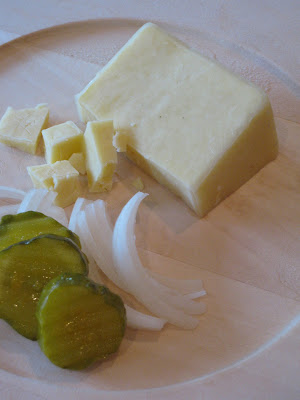
Whiskey Cheddar from County Limerick (I ought to have a limerick to go with this. There was a man from Nantucket, who … Oh dear, can’t share that one!) Rachel cut a sample taste and I was sold! It was so yummy!

Dave and Marion Cahill, of Cahill Farm, create this one. They’ve been offering cheese since the early 1980s in County Limerick, Ireland, and Marion makes flavored cheddars from vintage Limerick recipes. Some of their creations aren’t available in the United States, but we’re lucky to be able to purchase their Kilbeggan single-malt Irish Whiskey infused cheddar here.
Their semi-hard cheese is made from pasteurized Friesian cow’s milk, and Marion uses vegetable rennet to separate the curds and whey, making Cahill’s a vegetarian choice. They also make their farmstead cheddar with Irish Porter they brew themselves (like Guinness Stout) and another cheddar flavored with elderberry wine.

I am interested in why people decide to make cheese. The typical thought is that the skill has been honed through generations of farmers and cheesemakers, and sometimes that is the case. However, Marion Cahill was once a bank clerk, but decided to become a cheesemaker in 1966 when she and Dave married. Years later and with the help of a small dedicated staff, they are an established gourmet cheese legend!

How does it taste? Faith & Begorra!!!! It is wonderfully mellow and a little tangy, but not sharp, and there’s also a delightful “breath” to it, I suppose because of the whiskey infusion. The alcohol disappears during the aging process, but a pleasant residual complexity remains. Delightful!

Somewhere I read that a traditional country ploughman’s lunch consisted of cheddar and pickles. There is a Country Ploughman’s served at The Honor Oak in London that consists of honey roast ham, Dorset cheddar, pickles, Braeburn apple and bread. Sounds great to me!

One cool service that I appreciate at Quel Fromage is that on their sales receipt is a little history of the cheese you’re buying, the price, suggested beverage pairings and what to serve with the cheese.

Quel Fromage suggested serving this cheese with pickles and sweet onions, and with whiskey, pale ale, Riesling, or Gewurztraminer.

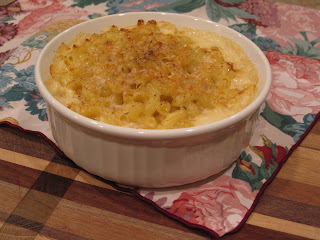
I tried it with a bread-n-butter type of pickle I had in the frig and sweet onions. It was okay. I also ate it with braeburn apple slices, which was excellent, and I used some of it, with 2 other cheeses, in a mac-n-cheese, washed down with some Riesling, that was marvelous!
There’s also a Kerrygold Aged Cheddar with Irish Whiskey, that has a similar robust flavor, with distinctive undertones of smooth, nutty taste. There could be others that I’m just not aware of. If interested, check out the selections and taste for yourself how they differ in taste slightly or greatly!

I may have been a day late for St. Patrick’s Day 2010, but I can now enjoy a wee bit o’ the Irish any ol’ time I want throughout the year!
I hope you’ll enjoy this Whiskey Cheddar from County Limerick, too!
PS I just read on Wikipedia that the shortest St Patrick's Day parade in the world takes place in Dripsey, Cork. The parade lasts just 100 yards and travels between the village's two pubs.

Friday, March 12, 2010

It's a matter of personal preference ...


Yesterday I went into our little beach market on the corner and handed the cashier a couple of heads of garlic I wanted to buy. As she rang up the purchase, she said she had never used fresh garlic; she just sprinkled on what she wanted from a little jar of dried garlic powder. I told her how simple it is to use garlic cloves and how it makes whatever one is cooking so much tastier. She said she would have to try it one of these days. I knew she was just being polite and I didn’t belabor the issue … to each their own …

But, the conversation got me to thinking about the Parmesan article I just uploaded and the vast taste difference between Kraft grated Parmesan and grating my own imported Parmesan.

Cooking with the freshest ingredients results in better tasting food. It may take a little more time and it may cost a little more for your groceries, but it’s better for you and tastes better--a good value in my estimation!

Speaking of good tastin’ stuff, try out this appetizer recipe that combines Parmesan AND garlic:

Hot Garlic-Parmesan Soufflé

15 cloves garlic peeled
2 cups low-sodium chicken broth or stock
2 (8-ounce) packages cream cheese, room temperature
(Dare I suggest substituting Mascarpone—Italian style cream cheese—for cream cheese??? It IS more $$$ Maybe we’ll save Mascarpone for another day. Or, perhaps you have a local creamery that makes its own cream cheese! Yay!)
1 cup freshly grated Parmesan cheese
1 (10.5-ounce) can cream of low-sodium mushroom soup, undiluted
2 egg yolks, beaten
1 loaf baguette bread, thinly sliced.

Preheat oven to 350 degrees F.

In a medium saucepan over medium-high heat, combine garlic cloves and chicken broth; bring to a boil and poach 15 minutes or until garlic is soft. Remove garlic cloves to a small bowl and allow them to cool. When cool, mash with a fork; set aside.

Cook and reduce chicken broth to a glaze; remove from heat and set aside.

In a large bowl, combine cream cheese, Parmesan cheese, mushroom soup, garlic-chicken glaze, mashed garlic, and egg yolks; stir until well blended. Transfer into a shallow ungreased 1 1/2-quart soufflé dish.

Bake, uncovered, 45 to 50 minutes or until golden brown. Remove from oven and serve with bread.

Serves many!
Enjoy!
PS ... of course you could go the extra kilometer, and make your own chicken broth with less sodium, and your own mushroom soup without all the preservatives, and use those in the above recipe. Wouldn't it be fun to see how much it actually DOES taste better making your own than using canned broth/soup?
Isn't it wonderful to have a choice?

Wednesday, March 10, 2010

Advantages of an 800-year old Italian Tradition ...


Pasta al dente, sauce bubbling ready, I had tossed in a bit of smoked salmon given to me by a friend. It all smelled heavenly! I had a small wedge of Reggiano Grassi Parmesan and grated enough for my spaghetti and I was soon in gastronome heaven!

Wait a minute now … gastronome seems a bit pretentious, so I looked it up: “Gastronome – a person devoted to refined sensuous enjoyment (especially good food and drink) bon vivant, epicure, epicurean, foodie, gourmet sensualist—a person who … “ I got the picture.

Food is a sensuous experience for me, but let’s get real! I hate being labeled, so let’s ditch the gastronome label. I digress …

When I reached into the frig for the cheese, I noticed my roomie had a readily identified green Kraft container of 100% Real Grated Parmesan Cheese. I’ve used this brand of grated parmesan cheese my whole life. If there was spaghetti or ravioli or whatever Italian dish on my dinner table, there was Kraft Real Grated Parmesan Cheese right next to it. I must admit, in all that time I consumed it, I had never read the label. Container said it was real cheese, it was parmesan, it went onto my pasta.

But now that I’m educating myself about cheese, I read labels:

Kraft
100% Real Grated Parmesan Cheese
No Fillers
Ingredients: Parmesan cheese (pasteurized part-skim milk, salt, less than 2% of enzymes, cheese culture, cellulose powder to prevent caking, potassium sorbate to protect flavor) aged 6 months.

Well now, powder to prevent caking and a preservative. They're not cheese.

A little investigation and I found that commercial parmesan cheeses common in North America typically differ from Parmigiano-Reggiano in several ways:

The cheese is aged for a shorter time, i.e., Kraft cheese is aged 6 months, whereas Grassi Parmigiano-Reggiano is aged a minimum of 18 months, Zanetti UCI Parmiagiano-Reggiano is aged 2-3 years. The longer the cheese ages, the more complex and desirable the taste.

The curds for Parmigiano-Reggiano are cut into fragments the size of wheat grains, which is much finer than the fragments created in the manufacture of the American version of Parmesan. The smaller curds drain more effectively.

American Parmesan is mechanically pressed to expel excess moisture.

Parmesan wheels in the United States average 24 pounds. The size difference can affect their salt saturation during the brining process; a typical 75 pound Parmigiano-Reggiano wheel contains two-thirds less salt than the average Parmesan.

It is often sold grated. Cheese will lose much of its flavor if it is grated, then stored. Better taste if you grate only as much as you’ll need for the meal.

There is no outside body regulating or supervising the quality of the raw ingredients or of the production process in the United States. In Italy, Parmigiano-Reggiano is completely regulated. No additives are permitted and cows must be fed a special diet—no silage—the milk is considered “grass-fed.” To produce the cheese, morning and evening milk are combined, skimmed, then heated in copper vats under the watchful eye of a master cheesemaker who knows just when the curd has set. The concave wheels are cured in brine for about 24 days and then placed on racks where they are turned and brushed continuously throughout curing. The regulating body comes in and tests throughout maturation of the cheese and does not add the coveted export stamp to the wheel unless it adheres to all production stipulations.

I’ve not researched … yet … who in the United States makes and sells a domestic Parmesan. But I did find a recipe for making Parmesan cheese in “Home Cheese Making” which includes recipes for 75 cheeses you can make at home and then recipes for cooking with cheese. Author Ricki Carroll writes her book in an easy to follow manner, and throws in all sorts of cheese lore. She’s also the owner of New England Cheesemaking Supply Company, which provides information and cheesemaking equipment and supplies.

Jumped around a bit this time, but the end result was spaghetti that was a totally satisfying taste sensation. Why go to all the time and effort of preparing good spaghetti and then cut it off at the knees by shaking on Kraft Parmesan, when you can quickly and easily grate your own and make the meal Benissimo!


Home Cheese Making, Ricki Carroll
Culture, the word on cheese, Spring 2009
The Cheese Plate, Max McCalman and David Gibbons
The Complete Idiot's Guide to Cheeses of the World, Steve Ehlers and Jeanette Hurt

Friday, March 5, 2010

Taking good health to heart ...


I had another article in mind to upload today, but it will wait. Instead I wanted to share something I read today as I wandered through the wonderful articles and descriptions and photographs in the current issue of "Culture." This is a delightful periodical ... "the word on cheese."
I'm repeatedly hearing about the sustainability purposing of the dairy folk I'm meeting. It's more than just the cheese; it's the whole package mentality. Taking care of the land, in turn, takes care of the milk stock, making better cheese ... ah ha! BUT, as I read an article by nutrition expert and author Dr. Marion Nestle, I learned yet another good effect of land taken care of takes care of me!

I've also had acquaintances comment that they don't eat cheese because of the "bad fat." I wondered about that. I keep eating cheese, but I wondered. The following is what Dr. Nestle had to say about both good fat/bad fat and the land ...

CULTURE:
"There's a lot of talk these days about "good" fat versus "bad" fat. Where does cheese fit into that discussion?

Dr. Nestle:

In a word: moderation! Saturated fat--the kind found in dairy products--is so-called bad fat, the kind that raises blood cholesterol and increases the risk of heart disease. Cheese is right up there as a leading source of saturated fat in the diet, along with other dairy products and beef. How worried should you be about this? It depends on what the rest of your diet looks like, how active you are, your weight, your genetic inheritance, and whether or not you smoke cigarettes. If you maintain a healthy lifestyle and if heart disease doesn't run in your family, the amount of cheese you eat eat isn't nearly as critical as it might be for someone in the opposite health situation.

Cheese lovers can also take heart (pun intended) in the hopeful results of newly emerging research about CLA--conjugated linoleic acid--a natural trans fat found in cheese and other dairy products made from the milk of cows that have fed on grass. CLAs appear to behave more like good fats, helping to improve cholesterol and triglyceride profiles in the body and maybe doing all sorts of other positive things such as preventing cancer, enhancing immunity, and strengthening bones. When one nutritional component is said to do so much, however, I'm usually skeptical. But the research on CLA is promising--stay tuned for more of it."

Dr. Nestle goes on to endorse moderation in cheese consumption for most people. Treat yourself to a moderate helping of a really excellent cheese, instead of a less than satisfying reduced fat cheese. Even a small portion of cheese grated on steamed veggies or in a hearty soup, or shavings included in a crisp spring greens salad, etc., are soooooo taste incredible! It isn't necessary to eat a whole wedge of cheese.

But, let's back up a bit. "... cheese and other dairy products made from the milk of cows that have fed on grass." Why, that sounds to me like exactly what the smaller local dairy folk I'm meeting are advocating and putting into practice. They pasture feed their milking stock, and while their fields aren't producing during the dead of winter, they have special feed to replicate those same nutrients their stock gain from being grass fed--no silage. You want cheese from grass fed milk!
I like the sound of CLAs behaving like good fat and providing all those marvelous advantages, don't you?
I encourage you to pick up a copy of "Culture" and finish reading the rest of Dr. Marion Nestle's article for other info about milk from different animals, and about vegetarianism.
I also encourage you to learn a little about the makers of the cheese you eat. A little self-education could add up to better health ... and a healthy appreciation for the artisan cheesemaker!

Tuesday, February 23, 2010

Who you callin' sophisticated?


I enjoy that friends are so gracious in sharing information they come across because they know I'm fascinated by artisan cheese and writing a blog about my encounters with cheesemakers and mongers. Janet McCall at The Northern Light in Blaine brought this quote to my attention:

"The increasingly sophisticated American palate for the 300 varieties of natural and specialty blended cheeses sold in the U.S. will pace future growth in a $14 billion retail market that is projected to be on fire by 2020, according to 'Natural and Specialty Cheese: The U.S. Market and a Global Perspective,' a first-of-its-kind report by market research publisher Packaged Facts. The retail natural and specialty blended cheese market showed healthy growth from 2005 to 2009, posting a compound annual growth rate (CAGR) of 7%. Packaged Facts projects the market will approach $17 billion by 2014."

That's a lot of cheese, folks! I found it interesting and encouraging seeing the volume of natural and specialty blended cheese being made here and/or imported. However, one aspect of that quote didn't feel right, "a sophisticated palate." I would have been more comfortable with the term "educated" rather than "sophisticated."

I'm definitely not sophisticated.

In meeting and talking with local creamery owners and cheesemakers, I've been impressed by their knowledge and talents, and moved by their hardships and victories, their passions and dreams. They are, for the most part, humble protectors and advocates for soil conservation, passionate about their livestock and their cheese, and taking pride in making the best product they can for their clients. Sophisticated is not generally a term I would use to describe them.

Then there are everyman, ordinary consumers, like me, who aren't interested in the elitist, social snobbery, of eating cheese deemed high-brow.

I hope to encourage more consumers to re-connect with their food sources. I'm not climbing up on my soapbox ... but ... I think it valuable for the health and welfare of our communities that local cottage industries be supported and sustained by folks who live right next door, particularly when they are providing a healthy, incredibly good tasting product!

Wow! Little did I realize that phrasing would tweak a nerve. If you want to be sophisticated, I promise I won't hold it against you! I'm simply trying to promote the benefit of educating myself (and maybe others) about artisan cheese and cheesemakers.


Monday, February 22, 2010

Fantastico!


Anneke Pearse, a dear friend and mighty proud mama, wrote to tell me that her son Erin and his wife Michelle sent a recipe to http://www.recipezaar.com/Easy-Crusty-Jalapeno-Cheese-Bread-Fantastico-354609 and she thought I might want to include it on Chatterbox Cheese. Wasn’t that nice of her? I do, indeed want to pass along this delectable bread recipe.
Check out the link for the m-a-n-y wonderful comments about this yummy bread! I also wanted to give credit to Brenda for the photograph that was included with the recipe on Recipezaar.

Although the recipe calls for a 15-oz package of shredded sharp cheddar cheese, I recommend you buy a locally produced sharp cheddar cheese and shred or grate it yourself. It DOES taste different!

Thanks, Anneke, for contributing to Chatterbox Cheese!

And thank you, too, Erin and Michelle!


MichelleAndErinFeb 8, 2009
Extremely simple yeast bread with cheddar & jalapeño ribbons; crusty exterior. A gorgeous artisan bread derived from "Jim Lahey's No-Knead Bread" method.

SERVES 12 , 1 round loaf

Ingredients

3 cups all-purpose flour (or bread flour)
1/4 teaspoon instant yeast (not regular yeast)
1 1/4 teaspoons salt
1 cup cornmeal
1 (15 ounce) jar sliced jalapeño peppers
1 (15 ounce) package shredded sharp cheddar cheese

Directions

1. Important: you will need a heavy pot with a lid. A Dutch oven is ideal; I just use a heavy stew pot with thick sides. I start the dough at 9pm if I want it for dinner the next day.

2. In a large bowl combine flour, yeast and salt. Add 1 5/8 cups water, and stir until blended; dough will be shaggy and sticky. Cover bowl with plastic wrap. Let dough rest at least 12 hours, preferably about 18, at warm room temperature, about 70 degrees.

3. Dough is ready when its surface is dotted with bubbles. Lightly flour a work surface and flop dough onto it. Fold it over on itself once or twice. Put some flour on your hands if the dough sticks to them. Cover loosely with plastic wrap and let rest about 15 minutes.

4. Divide the bag of cheese into 1/4s, and divide the jar of peppers into 4 portions, too, taking care to remove any stems or woody bits.

5. Remove plastic and press the dough flat. Sprinkle it with a portion of peppers and cheese. Fold in half, press flat, sprinkle again. I usually use only 3 of the 4 portions of cheese/peppers. Mash it into a ball, pressing firmly to seal the seam.

6. Generously coat a cotton towel (not terry cloth) with cornmeal; put dough seam side down on towel and dust with more cornmeal. Cover with another cotton towel and let rise for about 2 hours. When it is ready, dough will be more than double in size and will not readily spring back when poked with a finger.

7. At least a half-hour before dough is ready, heat oven to 450 degrees. Put a 6- to 8-quart heavy covered pot (cast iron, enamel, Pyrex or ceramic) in oven as it heats. When dough is ready, carefully remove pot from oven. Drop dough into pot, taking care not to burn your fingers. It may look like a mess, but that is okay. Shake pan once or twice if dough is unevenly distributed; it will straighten out as it bakes.

8. Cover with lid and bake 30 minutes, then remove lid and bake another 15 or longer, until loaf is beautifully browned. This may take as long as 60 minutes total bake time, but mine is usually done by 45 min total.

9. Cool on a rack. Listen to it crackle as it cools.

Monday, February 15, 2010

Silver Springs Creamery


Responding to an excellent article I read on Facebook about goat milk, a “comment” from Silver Springs Creamery popped onto my screen. I hadn’t before come across this creamery, so was intrigued to find out more about it.

I looked in my copy of Tami Parr’s “Artisan Cheese of the Pacific Northwest,” and there it was on E. Hemmi Road in Lynden, near Bellingham, WA. Nice surprise; only 30 minutes away from where I live!

I called and talked with Cara Flora, recently hired for product sales and marketing.
Eric Sundstrom is the owner/cheesemaker, who along with his daughter and son, keep the family farm running. Away I went to find out more about this local cheesemaker.

After many years working for others, Eric decided he could do better for his family and purchased his own farm in 2004, and in 2006 was licensed to make cheese from the milk of his herd of Jersey cows. The family had a devastating setback in 2007, but through sheer determination and hard work, they are back stronger than ever. It was evident while talking with Eric that aside from the fact that he’s a man of few words, he is firmly committed to and loves his farm, and is making the most of what he has. I could feel his resolve. I asked him what he loved best about his farm and he said, “Waking up early every morning and making it happen.”

When Tami’s book was published, Silver Springs Creamery had only Jersey cows and made Gouda and Jeddar (cheddar made with Jersey cows’ milk), yogurt, ice cream and sorbet.

Eric has since added to his 8 Jersey cows, some 20 Lamancha goats (an American breed with cute little nub ears close to their head) and is now offering goat milk, yogurt and gouda. He noted the increase in the demand for goat dairy products, and so moved forward to supply that demand. Silver Springs is a member of the PNW Cheese Project and a member of Sustainable Connections in Whatcom County. Respecting the land is Eric's priority, as that is what makes good milk and sustains his animals. He planted a specific blend of grains and grasses in his pastures and doesn't spray chemicals and uses organic fertilizers, which enable his animals to produce a better quality of milk.


I was provided with a sampling of just about all of their creations, and everything made my taste buds cheer with pleasure!

I was given Jersey cow milk ice cream (Vanilla and Coffee w/Heath Bar) and I ate them right away because I didn’t have good enough refrigeration at the office; several others helped me try out the ice cream. Both were so creamy and flavorful, and both get my thumbs up, although I especially enjoyed the Coffee w/Heath Bar!


I also enjoyed the fresh goat milk, and the goat milk yogurt. Oh my! The yogurt was a lot creamier than I anticipated. Had that great fresh yogurt taste, but loved the creamy consistency! Eric doesn’t include stabilizers. It’s all goat milk and live culture. Yum!

Ah … but now we get to the cheese!!!!!

You’ll find them listed and described on the Silver Springs website. So I’ll just add my own few comments.


La Jersey is a semi-hard cheese made from a blending of goat and cow milk. The two flavors I had—they offer plain, dill and onion, cumin, herb and black pepper—were both very smooth, velvety. I absolutely adored the Black Pepper! I ate it sliced on some crisp peppery crackers, and it was perfect! Definitely not too much pepper! I also had the Plain La Jersey, which was delicious both for snacking and grated onto my spaghetti last night.

Goat Gouda was a beautifully fresh tasting pale yellow cheese. Made in the traditional Dutch manner, but using goat milk instead of cow milk. This was excellent in sandwiches and as a snack by itself. I think Eric ages this cheese 4-6 months.

I also had a sample of The Big D, which is a crumbly, sharp Lamancha goat milk cheese. As the cheese ages, at least 6 months, it evolves in flavor. You’ll enjoy this robust, salty cheese.

I didn’t have a sample of Jeddar, which is Eric’s Jersey cow milk cheese aged at least 9 months. This sharp cheddar cheese should be available this summer. They also produce a classic cow milk Gouda, and Classic, goat milk aged hard cheese which is more mild than the sharp Big D.

Hard-working Eric seems to do it all! He does the milking and handling of the cows and does, AND he makes all the cheese. He creates all of his cheeses in 10-pound wheels, except for The Big D, which is made in 2-lb wheels. As you can guess, not all cheeses are available at all times. Call the farm store or check the website to find out what is ready for your enjoyment. However, Eric doesn’t quite do it all. His daughter and son, when not in school, also spend a lot of time helping with the 38-acre family farm. Eric’s son is quite proud of his free-range chickens and plans to add more to his flock. And, Cara Flora seems to be proving herself an excellent addition to the operation.

Silver Springs is a work in progress. A building houses the cheesemaking room, and the cheese aging room, with large viewing windows so visitors can see what it’s all about. Also in this building is the store and although you can now buy directly from the farm, soon the store will be enlarged to also offer free-range chicken eggs, and produce harvested from the 2 acres that will be planted with fava, spring greens, bok choy, lettuce mixes, onions, radishes and this summer Cara said they’ll have tomatillos, corn, tomatoes, hot peppers.

My photographs are rather winter dreary; everything looks better in the spring and summer months!

But there’s nothing dreary about the Silver Springs Creamery products! Although you can go out to the farm and buy the dairy products, it might be easier for you to purchase them at either of the Bellingham Co-ops,
the Skagit Co-op,
or Terra Organica.
You can also call the farm store or e-mail to have Cara ship an order of the available hard cheeses to you.

Eric plans to eventually provide a destination farm tour for visitors. I think it will be worth the wait!
In the meantime, do try all of the superior dairy products of Silver Springs Creamery. I heartily recommend them to you!


Silver Springs Creamery
Store Hours M-F 11 am - 4 pm
256 E. Hemmi Road
Lynden, WA 98264

(360) 820-1384


Thank you, Cara, for the photograph of Mt. Baker as seen from the farm!

And thank you, Eric, for taking the time to answer my questions and providing me with way more information than I could fit in this article!