Sunday, July 18, 2010

Good ol' Fashioned Community ...


I thoroughly relish how ideas unfold in the ripeness of time. I’m off on a tangent today, and won’t be chattering about cheese, per se.

I was channel surfing last night and happened upon a showing of the documentary “FOOD, Inc.” on the Public Television channel.
When it came out about a year or so ago, I was aware of it and the brouhaha it created. There was a lot of dialog; people were a-buzz over the revelations about corporate food industry and its unsettling impact on our way of life, on our health, on our choices, even on our perceived freedom. You know how Americans are about their freedom! But, I did not go see the documentary then.
I am grateful that I happened upon it last night. The ramifications are chilling, to say the least. I’m all for capitalism, every business should be able to be competitive and make a profit. It’s when business loses sight of ethics and makes choices that are counter to the local and global common good, in cut-throat/take no prisoners pursuance of profit to shareholders and strong-arm litigation and political leveraging, that makes me wonder what can be done by little ol’ me.
Other than my indignation over what the exposé shed light on, it started a train of thought about what’s being sold and bought in supermarkets, convenience at the expense of health, extraordinary corporate farming dependence upon petroleum products that enables the convenience in the supermarket, family farms and independents being forced out of the marketplace; the legal and political clout of behemoth food industry corporations, and why it makes a difference to me.
It’s frightening to think that a very few mega-corporations have maneuvered such control over our food sources, that if something went wrong with their engineered/cloned foods, there would not be anything else to fall back on. If they are systematically eliminating competition, we would have no other choices. This could have global consequences. We must preserve and support our local food sources. There’s a glaring and appalling imbalance.
There is more at stake than profit and convenience.
That got me thinking about local farmers, about local farmer markets, and my own interest in artisanal and farmstead cheeses.
The political buzzword these days seems to be “transparency.” I’m interested in these farms and creameries because there’s a face-to-face component that appeals to me. I know the cheesemaker. I know the area of the farm or creamery. I can talk to them. In some cases, I know their families and even the names of some the goats or cows. There’s accountability and accessibility. I know what they put in their cheese. In some places, I can even watch how they make my food.
It’s comforting and reassuring to know there are local sources for the salad greens I eat, for the yogurt and cheese and butter I eat, for the raspberries—oh baby, has there been a delicious crop of raspberries here this year at Boxx Berries—you get the picture.
But it’s more than a personal feel-good situation. If we don’t all in some way or another support our local food sources, they will continue to shrink and disappear … and then we’ll have nothing. It’s chilling to see the rapidly declining farmland in just Whatcom County alone (2007 Census of Agriculture: in 2002 there were 148,027 acres of farmland. In 2007 there were 102,584 acres of farmland. About 30% LESS!) Sustainability takes a community to make it happen. Also, when you buy locally, it benefits locally. Local farmers spent their profits at local service providers, so those revenues go to local public services and road maintenance and schools, etc., which benefit you and me.
It’s more than just supporting our local farmers. It’s also demanding accountability for the food being sold in supermarkets and mega-stores. Demand labeling so you know if your meat is shipped in from out of the country, contact your local political representatives and tell them you want to know if the food you’re eating is cloned or genetically altered. Don’t stand for the mega-producers legally preventing the consumer from making complaints or even questioning the way our food is produced. You DO have the power and the right to know what you’re eating and where it came from. Exercise that right. You don’t have to stand on a soapbox and shout expletives of anger and rage; just calmly send an e-mail or a Tweet to your congressmen and state representatives. There is strength in numbers! You plus me, plus Ann, plus Bill, plus … we count!
Educate yourselves! What is more vital than our source of food?
I came across the following web blog from Rainbeau Ridge, a farm in New York. Now, admittedly, New York is hardly local for us here in Birch Bay, but I like what Lisa Schwartz has to say in her blog. (Read her background. She was a management consultant who, in her fifties opted to change direction. In view of her passion for eating and sustainability, she bought her first pair of goats in 2003 and now has a thriving farm, supported by her community. She also has written a book. You can read more about her on her website.)
I like what she says because I feel that same local pride, a sense of community, a connectedness with the land and seriously, I think more people are feeling the same way.

RAINBEAU RIDGE WEB BLOG
http://www.rainbeauridge.com/
April 13, 2010
The Ties that Bind Us
The ties that bind us are sometimes impossible to explain. They connect us even after it seems like the ties should be broken. Some bonds defy distance and time and logic; Because some ties are simply... meant to be.
Grey’s Anatomy closing line episode 508

Much as I hate needing my car to get just about everywhere around here, I love a long, solitary drive. For me it’s think time.

Today I was thinking about ‘ties that bind us’ when I heard Neil Diamond singing Sweet Caroline at the Red Sox game, broadcast on the music station I was listening to. Not being a Diamond fan (no goats named in his honor!) nor a fan of the song, I found myself sporting a big, goofy smile as I listened to his rendition, voice scratchy with age and cigarettes(?), as the fans chimed in with the oh oh oh and “so good, so good” chants. For a few minutes, people of all persuasions came together for the silliest of songs, the connection to the game completely escapes me- but who cares—they’re having fun, all smiles and part of a community. In fact being amongst fans at a baseball game (assuming you have no interlopers from the opposing team) may be one of the few places these days where people enjoy being with others, regardless of politics, views on climate change or healthcare or anything else that matters.

Another venue that celebrates community is at Rainbeau Ridge on CAP pick up day—where our members come to shop for their weekly produce, eggs, cheese and other goodies. In this case, the ties that bind are more obvious. Some are confirmed locavores, others are just trying to find a way to connect to their food—the core of all who come to the farm share common ties of joy and interest in fresh and delicious food-- and it is palpable. The enthusiasm of each and every visitor feeds my soul—their happiness in being a part of CAP, the shopping and farm experience, meeting of neighbors and greeting new friends as connections are made, recipes traded—it’s such good ol’ fashioned community and I’m delighted and energized by what has emerged.”

So, that’s about it for today. Not too cheesy, I admit. But it’s what was on my mind. I have to go to Grace Harbor Goat Farm and buy some goat yogurt. It goes fabulously with the Boxx Berries raspberries. If my timing is right, they might even have some fresh chevre!

I’ll be back with cheese soon!

Tuesday, June 22, 2010

Huntsman Double Delight ...


Summer has been slow out of the gate this year in Birch Bay, WA. June has been uncharacteristically overcast, with periodic showers. It was on such a gloomy morning that I found myself in the cheese department, cheered by the sunshine yellow cheeses; little suns smiling up at me.

A visually attractive cheese piqued my eye and curiosity. Huntsman is a relatively modern combining of two English classics. It’s a Double Gloucester (cheddar) combined in alternating layers with Stilton (blue cheese). It’s layered by hand in a very complex labor-intensive process. Huntsman is a trademarked name of Long Clawson Dairy in England, but I’ve learned there are many imitations in the marketplace, including Stilchester. All of them are imported from England.

Huntsman is made with whole cow’s milk. Its name supposedly touts the region’s hunting tradition. Long Clawson Dairy was founded in 1911 when twelve farmers from the Vale of Belvoir, Leicestershire formed a co-operative to produce Stilton cheese in the village of Long Clawson. They now make 30 cheeses, including many innovative blended cheeses.

I love blue cheese and equally love cheddar, so imagine my delight in a cheese that combines the two! This double treat has the savory cheddar-like base Double Gloucester with a layer of creamy sharp, full-flavored Blue Stilton infused through the center. Some of the products made by others have multiple layering.


Because of the layering of the cheese, I would rather use it on a cheeseboard or as a snack or appetizer. However, it would be tasty on a grilled steak or a grilled hamburger with bacon. Yum! Have you ever tried a blue cheese on steak or a burger? Superlative taste experience!

I was at a loss for something quick for an early dinner, until I remembered the humble wedge of Huntsman waiting for me in the refrigerator.

I didn’t have a steak or burger to grill, so I simply sliced the Huntsman—both cheeses are pretty easy to cut—and paired it with quince paste, on a buttery multigrain cracker. The understated sweetness of the quince was a lovely counter to the savory and sharp cheeses. Oh baby! It was heavenly.

I read that it also goes well with chutney, and is often an alternative to traditional cheddar on a Ploughman Platter:

2 slices of fresh, crusty bread
1 Tbsp of Branston pickle
Half an apple, sliced
2 sticks of sliced celery
2 picked onions
1 sliced tomato
2 slices of Huntsman


I just came across this recipe for blue cheese, but I know it would be superlative with Huntsman:

Slice a French loaf or a hoagie or po’ boy bun in half, cover with pizza sauce and top with a mixture of chopped onions, mushrooms, tomato slice and Huntsman. Place it under the grill for five minutes and enjoy a warm, melty piece of heaven. Oh, I wish I had fixed that! De-lish!

I’m a white wine gal, so I enjoyed my simple repast with a crisp sauvignon blanc. However, I read that most frequently the recommendation is to pair this cheese with a Pinot Noir, Shiraz, Port, or other red wine. I understand it also goes well with just about any kind of beer or ale.

The recommended shelf life of Huntsman cheese is about 45 days. Just make certain you tightly wrap any leftover cheese in a fresh plastic or foil wrap, and store it in the warmest area of the refrigerator. For best flavor, remember to bring it to room temperature to eat it.

My recommendation? Try it! I’ll wager you’ll find there won’t be anything left to worry yourself about a shelf life!


Wednesday, June 2, 2010

The hunt was on for cheese! Any cheese, please!


Rummaging, I was, through the refrigerator searching for cheese; any cheese! I couldn’t find a single morsel. Nothing behind the half-full bottle of Sun Luck oyster sauce, nothing behind the mayo, nothing under the celery or the bok choy, nothing on the other side of the box of butter.

My anticipation was rapidly fading.

Wait! What’s that? I recognize that wrapping! Quel Fromage! What, oh what had I pushed all the way to the back of the top shelf and forgotten? More importantly, was it still edible or had it become just another moldy science project?

Lordy! Lordy! A wee bit of cave-aged Gruyère! Thanks be to the good god of all that is cheese!

I remember having used most of the originally purchased wedge in a 3-cheese sauce for macaroni, but with a shy ¼-cup of Gruyère left, there wasn’t enough for a sauce.

Gruyère is one of the firm raw cow’s milk cheeses of Switzerland that crumbles readily, but is well known for its superb melting capability. It’s the basis for any good Swiss fondue, and is preferred for au gratin onion soups. But I didn’t have enough for such.

The only recourse was to simply open my mouth and savor and enjoy each sliver and crumble. And enjoy it I did!

Because of the aging in a cave for at least 6 to 13 months to, in some cases, 3 years, and the process of washing the wheels of cheese, the taste of this Swiss cheese is more intense, more complex than some other Swiss cheeses. And especially more flavorful than most Swiss cheeses bricks and slices found in the supermarket.

I felt it stood on its own merit by eating it, rather than including it in a sauce—it was delicious! I love the words used by Sam Gugino, in the September 2008 issue of Wine Spectator magazine: “…a rich mouthfeel and a long finish.”

I didn’t eat it with crackers or apple slices because the taste was ever so slightly salty with a hint of sharp, and musty, and a complexity because of the aging, that I didn’t want to be distracted by any other taste.

In The Cheese Plate, authors McCalman and Gibbons say, “… one of the best things about Gruyère is that it’s salty on the attack but not on the finish.” I totally agree!

I did learn that a very good American Gruyère is made by the Swiss family, Wisconsin-based company Roth Kase.

Amazing the taste power in that slightly less than ¼-cup of Gruyère.

Sunday, May 16, 2010

2010 Seattle Cheese Festival


Photo credit: Nataworry Photography
Should have hyped this earlier, and now that it’s almost over I feel a little sheepish even mentioning it. Nonetheless, I felt moved to bring it to your attention in case you wanted to put it on next year’s calendar of things to do.

Pike Place Market, Seattle’s destination farmers market, is once again the venue for Seattle Cheese Festival, May 15 and 16, 2010. This is the annual go-to place for cheese foodies and general folk alike to taste, learn more about, and enjoy artisanal cheese locally made, and from around the globe!

Wander along the cheese concourse sampling dozens of cheeses. It’s an excellent opportunity to taste cheeses you may have never tried before and not have to buy a whole wheel or wedge of it from your cheesemonger or cheese retailer just to see if you like it. A treasure trove of experts are on hand to learn from and to broaden your cheese palate.

This is a marvelous opportunity, too, to buy these lovely cheeses directly from the producers who have taken time away from their milking and separating curds and whey to be on hand to meet you and tell you about their pride and joy!

I’ve wanted to attend this hoopla for years, but work demands have always kept me from joining in on the celebration.

If you were one of the lucky ones to have attended this year, I invite you to share your experience with me, and I’ll include your comments and/or photographs here on my blog, or send me links to your write-ups about the Seattle Cheese Festival and I'll include links directly to your commentary.
There are several dairies and creameries from my neck o’ the woods presently represented down in Seattle right now! Let me know how it went for you!

If you want to find out more about this festival or want to attend next year, view http://seattlecheesefestival.com/ for details.

2010 Cheese Concourse participants:
Agour
Ambrosi
Beemster Cheese
Chevre Noir
Interval
Isigny
KH De Jong
La Buchette
Le Pommier
Mt. Townsend Creamery
Papillon
Terre Des Volcans
Tournevent
Let’s all try to make it to this event next year, shall we?

Postscript
It’s a silliness on my part, but I've been told to go to Montana, a place I’ve never been before and really had little motivation to consider. Admittedly times and motivations change. But, Montana?

In putting together this entry about the Seattle Cheese Festival, I clicked randomly—was it really random—on the link of one of the participants at the Festival—Amaltheia Organic Dairy—only to find that it’s a goat cheese dairy in MONTANA! I love goat cheese!

Maybe I need to take a roadtrip to Montana, and learn a wee bit more about Melvyn’s and Sue’s operation in Belgrade, just outside of Bozeman.

Oops! Major faux pas!


In my last entry I went on and on about this wonderful cheese blogger I came across. I mean, I waxed to the max ...


However, I totally did a switcheroo on the name of Jeanne's blog. I've corrected it on my previous entry, but wanted to bring my error to the fore, just to make certain you get to the right blog!


Please visit Jeanne Carpenter's blog Cheese Underground! You'll correctly find her at http://www.cheeseunderground.blogspot.com/. It will be worth the effort!


My apology, Jeanne!


Friday, May 14, 2010

"Cheese is food, not a status symbol."


Since this interest in cheese has come over me, I’ve been following and learning from various cheese blogs. One that I particularly enjoy is Cheese Underground, written by Jeanne Carpenter in Madison, Wisconsin. She blogs mostly about up and coming artisan cheesemakers in Wisconsin, but she travels around to the many competitions and artisan cheese events nationwide and then reports on the latest.

Back in January, she wrote about a book she had just finished reading. I’ve included her entire blog entry here. On the basis of her recommendation, I went to Village Books in Fairhaven and purchased a copy. I have to agree 100% with Jeanne’s assessment! I found it to be so much more than just a book about artisan cheese and a cheesemonger.

The reason I’m bringing this up now is that Village Books, co-sponsored by Bellingham’s Community Food Co-op, is scheduled to have Gordon Edgar, the cheesemonger himself, at Village Books at 7:00 pm on Monday, May 17, 2010. I’ll be there just to see and hear this good fellow in person.

Here is what Jeanne wrote about Gordon in The Antithesis of a Cheese Snob, posted 18 Jan 2010 to Cheese Underground:

“’Cheese is food, not a status symbol.’

And with that simple sentence, Gordon Edgar won me over in his new book, ‘Cheesemonger, A Life on the Wedge’ (Chelsea Green Publishing, January 2010, $17.95). As the cheese buyer for Rainbow Grocery Cooperative in San Francisco, Gordon was a cheesemonger before cheesemongering was cool. He's the Barbara Mandrel of the cheese counter.

Fifteen years ago, this former punk rocker bluffed his way into being hired at Rainbow by proclaiming his favorite cheese was ‘anything raw and rennetless.’ Today, he's considered to be one of the hippest, most knowledgeable cheese buyers in the country.

I bought and sped read his book last week as a writing assignment for a magazine and have to admit I was not looking forward to it, as I've really started dreading reading cheese books. Most of the cheese guides hitting the book stores these days are full of pretentious verbiage written by people who assume that by reputation alone, they are THE authority on cheese.

Not Gordon. While several parts of his book caught me off guard - as in spew coffee through my nose surprised - the preface alone was enduring. Here's how Gordon starts:

‘There are plenty of great cheese guidebooks out there. This is not one of them.’ Alrighty then. Well, Cheese Underground readers, I guarantee that by the end of Gordon's book, you'll disagree. While ‘Cheesemonger is billed as the story of one guy's memoir of his journey into the cheese business, it's also an inspiring, introspective read for people like me who have always struggled with being cool enough to fit into the hip cheese crowd.

Not that I really fit into any hip crowd - evidenced by the episode this morning at the doctor's office with my daughter. After speed reading Gordon's book for the assignment last week, this week I've been carrying it with me everywhere, taking my time, re-reading it word for word and highlighting passages that especially speak to me. My daughter, who is almost always embarrassed by the fact that she has a mother who eats and writes about cheese for a living, was literally mortified when I pulled the book out of my bag and started talking it up to a complete stranger this morning who, like us, was waiting for his throat culture results (strep throat is making the rounds). Avery immediately ditched me and sprinted across the room, not wanting to be seen sitting with the resident cheese geek.

But now, thanks to Gordon, I fully and whole-heartedly am embracing my inner cheese geekness. I am proud to join Gordon as a fearless leader of non-snobs o' cheese everywhere, keeping in mind that ‘in the end, the cheese always does the talking.’

Amazing cheese doesn't need people like me describing it as a frou frou piece of art. It also doesn't need pretentious authors talking up its "artisan" characteristics or its ‘terroir.’ One of my favorite parts of Gordon's book is actually the ‘Cheese Buying for Beginners’ appendix, with helpful hints such as to spend your money on real Parmigiano Reggiano. He states: ‘Some Reggianos are better than others, but all are top quality. For the sake of Sweet Cheesus, don't buy it pre-grated unless you doing a large event.’

Gordon reminds the reader that after all, cheese is just food. Eat it. Enjoy it. Don't be afraid of it, and don't let other people tell you what you like or dislike. And by all means, ‘buy the cheese that makes you happy.’ Well said.”

And with that well said by Gordon and Jeanne, if you’re in the area, I encourage you to go see Gordon Edgar at Village Books on Monday, May 17th! I’ll definitely be there and look forward to seeing a full house of cheese geeks!

Village Books, 1200 Eleventh Street, Bellingham WA 98225
(360) 671-2626
http://www.villagebooks.com/


Jeanne Carpenter, author of Cheese Underground
http://www.cheeseunderground.blogspot.com/

"Gordon Edgar, Cheesemonger: A Life on the Wedge"
$17.95 ISBN-13: 9781603582377
Chelsea Green, Publishing Company

Tuesday, May 4, 2010

Thank Goodness for Mommy!


Mother’s Day advertising is blossoming all over the television, the newspapers, magazines, walking through the mall, et cetera, as the countdown to May 9th continues. Remember good ol’ Mom! May comes along and we inevitably think of mothers and Mother’s Day, yes?


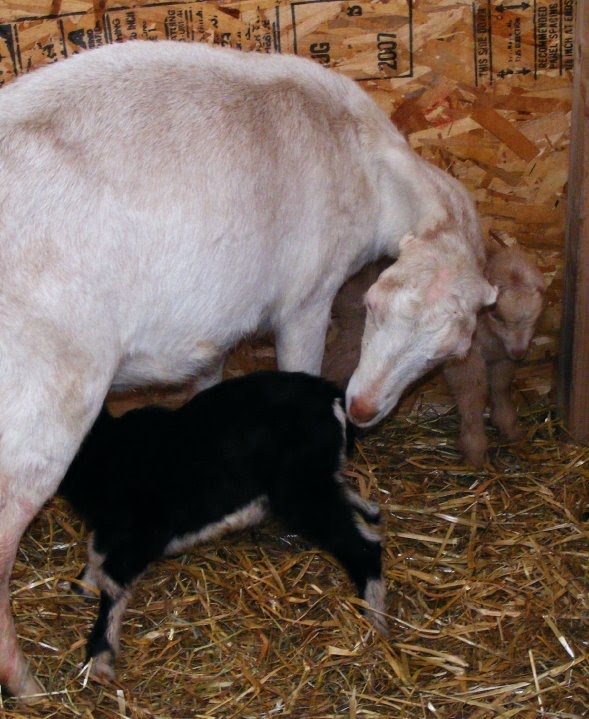
It struck me, as I was eating some fresh goat chevre, that I wouldn’t be enjoying that delectable treat if it weren’t for a mother, or lots of mothers; goat mothers, sheep mothers, cow mothers, buffalo mothers.
Bless those mothers!

I enjoy this time of the year when babies are being born; they are so adorable. Who isn't emotionally moved by cuddly young babies? I love, too, that milk is starting to flow and cheeses are being created. Some cheeses are enjoyed fresh, others need to age before they’re at the point of enjoyability—is there such a term?

As I talk with folks throughout my day-to-day activities, there sometimes seems still to be a disconnect about how food is made before it is delivered to our supermarkets and placed on the market shelf or in the refrigerated cooler. Not only are some children clueless about where milk and cheese come from—or French fries, bread, or hot dogs, or catsup and mustard—but some adults also aren’t cognizant that the “mother” has to be lactating in order for there to be milk, and therefore, cheese.

Cow’s milk is a major industry here in the United States and the availability is managed so that cow's milk is combined from many different sources so that it’s in the store refrigerator year around.

But, if you’re an artisan creamery, and you have a finite number of cows, or sheep, or goats, then the lactation cycle is much more obvious; some cheeses are only available during a specific time of the year.

Although some artisan cheese dairies and creameries practice extended lactation management, the following appear to be the norm:

Ewe (sheep) lactation
is about 180 days.
Doe (goat) lactation
is about 300 days
Cow lactation
is about 305 days

I’m not sophisticated enough to understand the animal husbandry whys and wherefores, but I know that during certain months I can’t get some of the cheeses I enjoy. However, that makes those cheeses that more appealing and cherished when they are available at my cheesemonger’s counter!
Therefore, I want to applaud mothers everywhere and in every realm!

Happy Mother’s Day!

Postscript
On Fox News a few weeks ago, there was a mention of a NY restaurant owner, Daniel Angerer, who made cheese from his fiancee’s milk. Public reactions were mixed, which seems a little silly to me. If I had been interested in artisan cheese when I was lactating with my two sons, I think I would have been curious enough to try to make some cheese from my own milk.

Does it creep you out that patrons were eating cheese made from human mommy’s milk?